Why responsible gambling requires professional judgement, context and genuine attention to the person behind the data
In Responsible Gambling, we work with data every day.
We look at deposits, losses, playing frequency, session duration, changes in behaviour and many other indicators that can help us identify potential risk. Technology has become increasingly good at recognising patterns that deserve our attention, often much earlier than we would have been able to identify them manually.
That is an important development.
But whenever I review an RG alert, I try to keep one thing in mind.
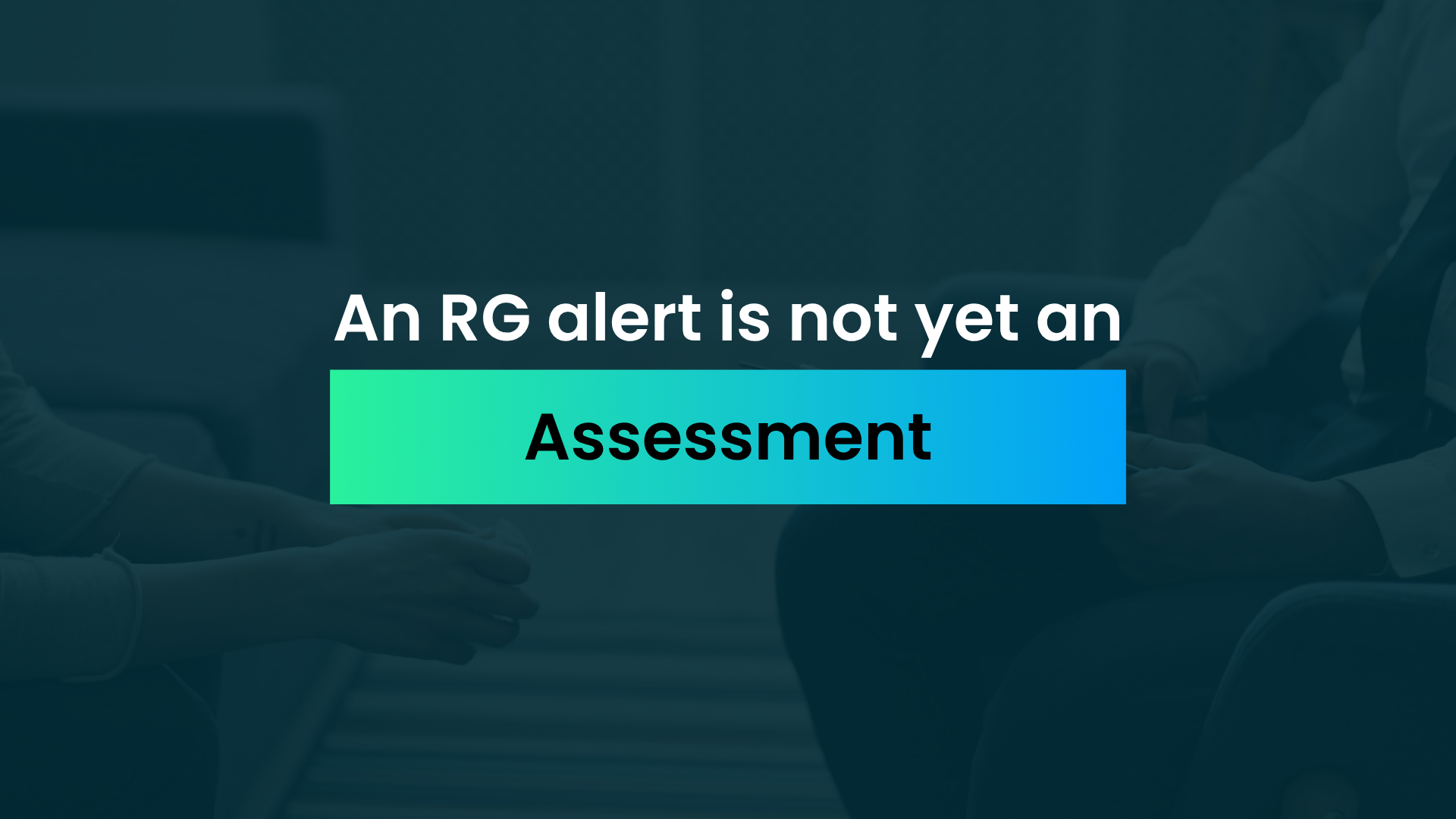
An alert tells me where to look.
It does not yet tell me what I am looking at.
That distinction may sound small, but in practice it is fundamental to good Responsible Gambling.
A player can trigger an alert because their gambling activity has increased, because deposits have become more frequent, because they have sustained higher losses or because their behaviour has changed compared with their usual pattern.
Those signals matter. They should never simply be ignored.
At the same time, the presence of a signal does not automatically mean that gambling harm is present.
It means that we have a reason to assess.
And for me, that is where Responsible Gambling really begins.
Looking beyond the signal
Two players can show almost identical patterns in the data while their personal circumstances are completely different.
One player may have temporarily increased their gambling activity, while remaining fully aware of their spending and financially able to absorb the losses involved. There may be no meaningful impact on daily life, no loss of control and no indication that gambling has become problematic.
For another player, the same behavioural change may be occurring during a period of financial pressure, emotional distress or significant change in their personal life. Gambling may have started to serve a different function. What previously was recreational activity may gradually have become a way to escape, regulate emotions or cope with stress.
The data may look similar.
The level of risk may not be.
This is why I believe professional interpretation remains such an important part of Responsible Gambling.
Compliance frameworks, thresholds and monitoring systems give us necessary structure. They help us work consistently and ensure that signals are identified and acted upon.
But good duty of care requires more than following a process.
It requires us to understand what the process is trying to protect.
Ultimately, that is the wellbeing of a person.
Professional curiosity is part of duty of care
When an alert appears, I do not think the first question should be: what intervention should we apply?
I think the first question should be: what might be happening here?
Has something changed in this player’s behaviour?
Is the current level of gambling financially sustainable?
How does the player themselves experience their gambling?
Do they still feel in control?
Are there signs that gambling is affecting other areas of life?
Is the behaviour consistent with previous patterns, or are we seeing a meaningful change?
These are not questions a monitoring system can answer on its own.
They require judgement.
Sometimes the available account information gives us enough context to make a proportionate assessment. At other times, the most valuable source of information is the player themselves.
That is why I still see conversation as one of the most important tools we have in Responsible Gambling.
A genuine conversation can reveal things that no transaction history can show.
A player may tell us that the amounts they are spending are well within their means and that they are comfortable with their current limits. That explanation may fit everything we can see in the account.
But another player may tell us that they have recently started gambling more because they are struggling with stress, loneliness, financial pressure or difficulties elsewhere in their life.
Both conversations matter.
Responsible Gambling is not only about identifying when something is wrong.
It is also about assessing carefully enough that we do not assume something is wrong when the evidence does not support that conclusion.
The wider context matters
My own background in care has strongly influenced how I approach this work.
In healthcare, behaviour is rarely viewed in isolation. We try to understand what may be happening around the behaviour, what function it might serve and what has changed for the person.
I believe there is value in bringing some of that way of thinking into Responsible Gambling, without turning gambling operators into healthcare providers.
Mental wellbeing, stress, major life events, coping strategies, impulsivity and emotional regulation can all influence gambling behaviour.
Neurodivergence can also be part of that wider context.
It is important to be very precise here.
Neurodivergence itself should never be treated as evidence of gambling risk. Neurodivergent people are not one homogeneous group, and a diagnosis should never become a shortcut for assuming vulnerability or harm.
At the same time, individual characteristics can sometimes help us understand behaviour.
A person may be particularly sensitive to reward or stimulation. Someone may struggle with impulse control. Another person may use repetitive behaviour as a way of regulating stress. Some people may find it difficult to recognise their own signs of overload until they have already crossed their limits.
None of this automatically means that gambling is harmful.
But when we are trying to understand a change in behaviour, these factors may form part of the wider picture.
The same is true for mental health more broadly.
Sometimes an increase in gambling is not primarily a gambling story.
It may be part of a stress story.
A grief story.
A financial story.
A loneliness story.
Or simply a period in which someone’s usual ability to regulate, reflect and make decisions has changed.
We do not need to diagnose that person to recognise that context matters.
Knowing the boundary of our role
A Responsible Gambling Officer is not a psychologist, psychiatrist or addiction therapist.
And we should not try to become one.
Our role is not to diagnose mental health conditions or determine why someone behaves in a particular way from a clinical perspective.
Our role is to identify potential gambling related harm, assess the available information carefully and determine what action is appropriate within our responsibility as an operator.
That boundary matters.
A good RG assessment should therefore combine several perspectives.
We look at behavioural data.
We look at transaction history.
We consider previous alerts and interventions.
We look at changes over time.
Where relevant, we assess affordability.
And sometimes we speak directly with the player.
The value lies not in any single piece of information, but in bringing those pieces together.
That is where an alert becomes an assessment.
Care also means avoiding assumptions
There is another side to duty of care that I think deserves more attention.
We rightly focus on the importance of identifying gambling harm early.
But early detection should not become automatic labelling.
If every RG alert is treated as proof that a player is experiencing gambling harm, we stop assessing and start assuming.
That is neither fair to the player nor good professional practice.
An alert should create a reason to look more closely.
It should not predetermine what we are going to find.
Sometimes an assessment will lead to a direct intervention.
Sometimes limits need to be discussed.
Sometimes additional safer gambling information or tools are appropriate.
Sometimes further contact is necessary.
And sometimes the conclusion may genuinely be that no additional intervention is required at that moment.
That does not mean the alert was unnecessary.
It means the assessment did what it was supposed to do.
The purpose of Responsible Gambling should not be to intervene as much as possible.
The purpose should be to intervene where it is necessary, proportionate and likely to protect the player from harm.
For me, that is also what good compliance looks like.
Not simply being able to demonstrate that a process was followed, but being able to explain why a particular decision was made and how that decision relates to our duty of care.
Technology can detect more, but people still need to interpret
The role of technology in Responsible Gambling will continue to grow.
Behavioural modelling, machine learning and more advanced monitoring systems will allow us to identify increasingly subtle patterns and changes in player behaviour.
I welcome that development.
The earlier we can identify meaningful changes, the earlier we have an opportunity to respond.
But better detection does not reduce the need for human judgement.
In many ways, it makes human judgement even more important.
The more signals we are able to generate, the more carefully we need to distinguish between a signal, a risk and actual evidence of harm.
Technology can help us recognise that something has changed.
A professional still needs to ask what that change means.
And sometimes, to understand that, we need to speak to the person behind the account.
That is why I believe the future of Responsible Gambling should not be a choice between data and human judgement.
We need both.
We need strong systems that help us detect potential risk as early as possible.
We need clear compliance frameworks that ensure those signals are taken seriously.
And we need trained professionals who understand that care, context and proportionality are part of the assessment too.
Because ultimately, gambling harm does not happen in a dataset.
It happens in someone’s life.
And if our duty of care is truly about preventing harm, that is the perspective we cannot afford to lose.

By Simone van der Heijdt, Responsible Gambling Officer and Addiction Prevention Representative